📋 Quick Summary
In this article:
- The Short Answer: Can Cracked Granite Be Repaired?
- Is It Really a Crack or a Natural Granite Fissure?
- What Types of Granite Countertop Cracks Can Be Repaired?
- What Determines Whether Granite Can Be Successfully Repaired?
- Need Granite Countertop Repair Help?
- What Happens During Professional Granite Countertop Crack Repair?
- Will the Crack Be Completely Invisible After Repair?
- How Long Does a Repaired Granite Countertop Last?
- When Should a Cracked Granite Countertop Be Replaced?
- Why Repairing Granite May Be Better Than Immediate Replacement
- What Should Philadelphia Homeowners Do Immediately After Finding a Crack?
- Should You Attempt DIY Granite Crack Repair?
- Questions to Ask a Granite Countertop Repair Company
- How to Protect Granite After Professional Crack Repair
- Professional Granite Countertop Crack Repair in Philadelphia, PA
- Areas Served by Tri-State Marble Countertop Care
- Additional Countertop Repair and Restoration Services
- Frequently Asked Questions About Cracked Granite Countertops
- Contact Tri-State Marble Countertop Care
Discovering a crack in a granite countertop can leave a homeowner with an immediate question: can the countertop actually be repaired, or is complete replacement the only practical option?
The good news is that many cracked granite countertops can be professionally repaired. The possibility of a successful repair depends on several factors, including the type of crack, its location, the amount of movement in the stone, the condition of the cabinets underneath, previous repair attempts, and the overall condition of the countertop.
Some cracks are primarily cosmetic. Others indicate structural movement that must be corrected before the visible damage is restored. Understanding the difference is important because simply filling a crack without addressing its cause may result in the damage returning.
This Philadelphia homeowner’s guide explains how professionals evaluate cracked granite, which types of damage may be repairable, when replacement should be considered, what the repair process involves, and how homeowners can reduce the risk of future countertop damage.
The Short Answer: Can Cracked Granite Be Repaired?
In many situations, yes. A cracked granite countertop can be repaired without removing and replacing the entire countertop installation.
Professional repair methods may be used to stabilize damaged stone, bond separated sections, fill visible cracks, reinforce vulnerable areas, level uneven surfaces, coordinate repair materials with the granite color, and restore the surrounding finish.
However, not every crack should be treated the same way.
🔑 Key Insight
A short, stable crack located in an open section of granite presents a different repair situation from a fracture extending through a narrow sink rail. A separated seam requires a different approach from an impact crack along the countertop edge. A crack caused by cabinet settlement may continue to move unless the underlying support problem is addressed.
The first step is determining what kind of damage is present and why it occurred.
Is It Really a Crack or a Natural Granite Fissure?
Before planning a repair, homeowners should understand that not every visible line in granite is damage.
Granite is a natural stone formed through geological processes. Mineral variations, veins, pits, and fissures can be part of the natural character of a slab.
What Is a Natural Fissure?
A fissure is a naturally occurring separation or mineral feature within the granite. Fissures are often visible from the time the countertop is installed and may follow the natural pattern of the stone.
They do not necessarily indicate that the countertop is failing.
What Is a Granite Crack?
A crack is damage that occurs after or during fabrication, transportation, installation, or use of the countertop.
Cracks may develop because of impact, inadequate support, cabinet movement, stress around openings, excessive weight, or other structural conditions.
How Can a Homeowner Tell the Difference?
It is not always easy to distinguish between a fissure and a crack without professional experience.
A line that has recently appeared, continues to grow, catches a fingernail, creates movement between countertop sections, or produces an uneven surface should be evaluated.
When there is uncertainty, a professional stone technician can inspect the area and recommend whether repair is necessary.
What Types of Granite Countertop Cracks Can Be Repaired?
The repairability of granite depends more on the condition and stability of the countertop than on the simple presence of a crack.
The following are common types of granite damage that may be candidates for professional restoration.
Hairline Granite Cracks
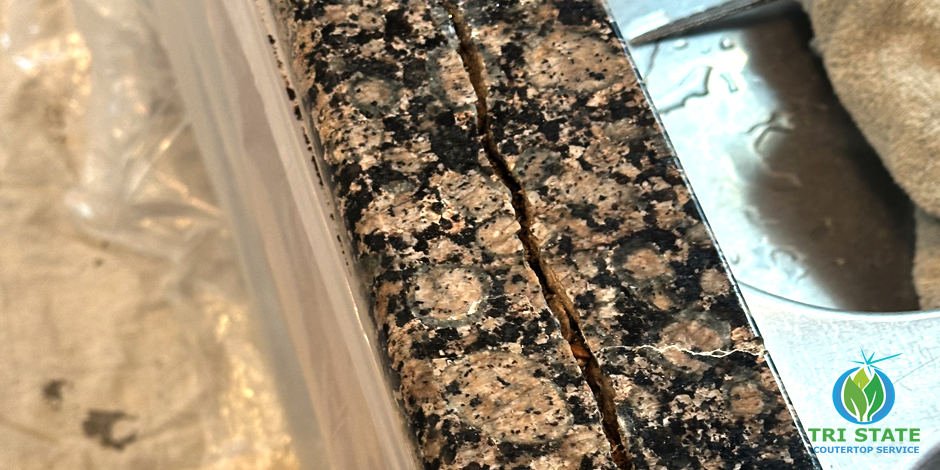
Hairline cracks are narrow fractures that may initially appear minor.
When the surrounding countertop remains stable and properly supported, professional repair materials may be used to fill and seal the damaged area.
However, homeowners should monitor hairline cracks carefully. A crack that continues growing may indicate movement or structural stress.
Cracks Near Granite Countertop Edges
Countertop edges can be damaged by dropped cookware, appliances, tools, furniture, and other heavy objects.
Localized edge cracks can often be repaired by bonding the damaged stone, rebuilding missing areas when necessary, reshaping the edge, and restoring the surface finish.
Cracks Around Sink Openings
The narrow strips of granite located in front of and behind a sink are commonly called sink rails.
These sections can be vulnerable because the stone has been reduced to accommodate the sink opening.
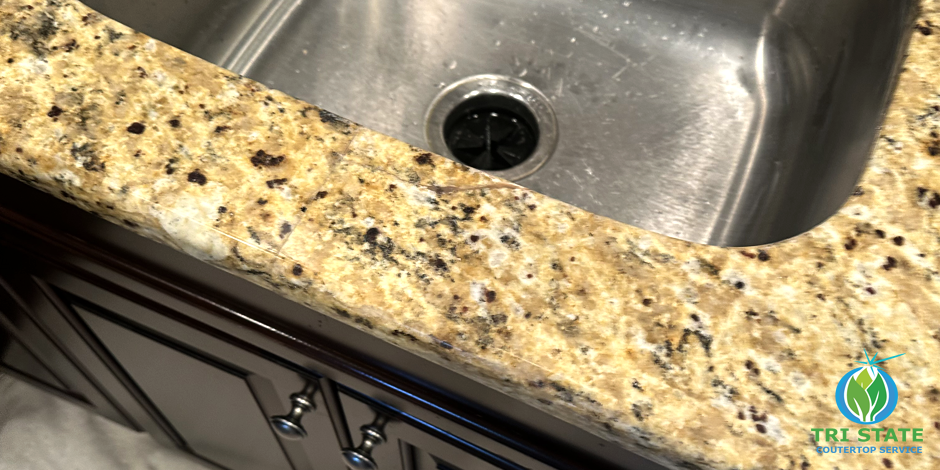
Cracks around sinks may be repairable, but professional evaluation is particularly important because the stone may require stabilization or reinforcement.
Cracks Around Cooktop Openings
Cooktop corners are another area where granite can experience concentrated stress.
Cracks may develop because of insufficient support, fabrication issues, heat-related stress, movement, or impact.
Depending on the condition of the stone, these cracks may be repaired and reinforced.
Cracks Along Countertop Seams
Sometimes homeowners describe a separated or failed seam as a crack.
Countertop seams can deteriorate because of adhesive failure, cabinet movement, settlement, moisture exposure, or improper installation.
Professional seam restoration may involve removing deteriorated adhesive, cleaning the joint, realigning countertop sections, bonding the seam, leveling the surface, and improving its appearance.
Impact Cracks
A heavy object dropped onto granite can create cracks, chips, or broken sections.
Localized impact damage may be repairable when the surrounding countertop remains structurally stable.
If pieces of granite have broken away, homeowners should keep the original fragments whenever possible and avoid applying household adhesives before contacting a professional.
Cracks That Have Been Previously Repaired
A failed repair does not automatically mean the countertop must be replaced.
A professional technician may be able to remove old repair materials, evaluate the underlying stone, stabilize the damaged area, and perform a new repair.
However, previous DIY products can increase the complexity of the restoration.
What Determines Whether Granite Can Be Successfully Repaired?
Several factors help a stone restoration professional determine whether repair is practical.
Is the Countertop Still Structurally Stable?
Structural stability is one of the most important considerations.
If the countertop sections move independently, the repair may require reinforcement before cosmetic restoration begins.
Continuing movement can cause a repaired crack to reopen.
What Caused the Crack?
Understanding the cause of the damage is essential.
If the crack resulted from a one-time impact and the countertop remains stable, the repair may be relatively straightforward.
If cabinet settlement, insufficient support, or ongoing structural movement caused the damage, those conditions should be considered during the repair process.
Where Is the Crack Located?
Location affects accessibility, repair methods, reinforcement requirements, and cosmetic restoration.
Cracks in open countertop sections may be easier to access than damage behind faucets, against backsplashes, around sinks, underneath appliances, or near walls.
How Wide and Deep Is the Crack?
A narrow surface crack requires a different repair approach from a full-thickness structural fracture.
The technician may evaluate whether repair materials can penetrate the damaged area and whether additional reinforcement is necessary.
Are Pieces of Granite Missing?
Missing material can increase repair complexity.
Small areas may sometimes be rebuilt using professional stone restoration materials. Larger missing sections may require more extensive reconstruction or replacement.
Has Someone Already Tried to Repair the Damage?
Household glue, silicone, caulk, consumer epoxy, and other materials can interfere with professional bonding products.
Existing materials may need to be carefully removed before a new repair can be completed.
What Happens During Professional Granite Countertop Crack Repair?
Professional Granite Countertop Crack Repair in Philadelphia, PA is a multi-stage restoration process. The exact methods depend on the damage and countertop condition.
Countertop Evaluation
The technician begins by examining the crack, surrounding stone, seams, sink or cooktop openings, cabinet support, and countertop alignment.
The evaluation helps determine whether the damage is cosmetic or structural.
Identifying Movement and Support Problems
The countertop may be checked for movement, uneven sections, unsupported areas, and other conditions that could contribute to future cracking.
Addressing stability is important before the visible crack is restored.
Preparing the Damaged Area
The crack and surrounding granite must be cleaned and prepared.
Grease, dust, moisture, household cleaners, loose particles, and old adhesive can reduce the effectiveness of professional repair materials.
Aligning and Stabilizing the Stone
When countertop sections are uneven or moving, specialized methods may be used to align and stabilize the granite.
Some repairs may require reinforcement to improve structural support.
Filling and Bonding the Crack
Professional stone repair materials are selected based on the type of granite, crack condition, location, and repair requirements.
Resins, epoxies, adhesives, pigments, and other restoration materials may be used.
Matching the Granite Color
Granite contains unique mineral colors and patterns.
The technician may adjust the repair material to reduce contrast with the surrounding stone.
The goal is to make the repaired area less noticeable while restoring stability and functionality.
Removing Excess Material and Leveling the Surface
After the repair material cures, excess material is carefully removed.
The repaired area is leveled to create a smooth transition with the surrounding countertop.
Restoring the Countertop Finish
Depending on the surface and repair location, honing, polishing, or other finishing techniques may be used.
The objective is to coordinate the repaired section with the surrounding countertop texture and sheen.
Will the Crack Be Completely Invisible After Repair?
This is one of the most important questions homeowners should ask before scheduling service.
Professional repair can significantly reduce the appearance of many granite cracks, but complete invisibility cannot be guaranteed.
The final appearance depends on the granite color, mineral pattern, crack width, missing material, location, previous repairs, surface finish, and extent of structural damage.
Highly patterned granite may naturally help disguise a repair. Uniform granite can make color differences easier to notice.
A professional repair should focus on stabilizing the countertop, restoring functionality, improving appearance, and extending the useful life of the stone.
How Long Does a Repaired Granite Countertop Last?
A professionally repaired granite countertop can provide a durable result when the underlying cause of the crack has been addressed and the countertop remains properly supported.
The longevity of a repair depends on several factors.
Continued cabinet movement can place stress on the repaired section. Standing or sitting on countertops can damage narrow or unsupported areas. Repeated heavy impacts may create new cracks. Improper countertop use can also reduce the service life of a repair.
Homeowners should follow professional maintenance recommendations and monitor the countertop for future movement.
When Should a Cracked Granite Countertop Be Replaced?
Although many cracks can be repaired, there are situations where replacement may be more practical.
Multiple Severe Structural Fractures
A countertop with extensive fractures across several sections may not be a good candidate for localized repair.
Major Cabinet or Structural Problems
If the countertop support system is severely damaged or unstable, correcting the underlying structure may require removal of the granite.
Large Missing Sections
Significant loss of stone material can make reconstruction difficult or cosmetically undesirable.
Extensive Previous Repair Damage
Multiple failed repairs, heavy grinding, permanent discoloration, and incompatible adhesives can reduce restoration options.
Planned Kitchen Renovation
If the homeowner is already planning new cabinets, a different countertop layout, or a complete kitchen renovation, investing in extensive repair may not be practical.
A professional evaluation can help homeowners compare repair and replacement based on the actual countertop condition.
Why Repairing Granite May Be Better Than Immediate Replacement
Replacing a granite countertop can become a significant project.
The process may involve demolition, disposal, plumbing disconnection, sink removal, appliance adjustments, purchasing new stone, fabrication, transportation, installation, seam work, and possible modifications to cabinets or backsplashes.
Matching an existing granite pattern can also be difficult when only one countertop section is damaged.
If the original granite remains attractive and structurally repairable, professional restoration may preserve the existing countertop and reduce unnecessary disruption.
Repairing natural stone can also help homeowners continue using a material they selected specifically for its appearance and character.
What Should Philadelphia Homeowners Do Immediately After Finding a Crack?
Actions taken after discovering countertop damage can affect future repair options.
Do Not Apply Household Glue
Avoid super glue, construction adhesive, silicone, caulk, and other household products.
These materials can contaminate the crack, discolor the granite, and make professional restoration more difficult.
Avoid Putting Weight on the Damaged Area
Do not stand, sit, or place heavy appliances near the crack.
This is particularly important when damage is located near a sink, cooktop, countertop edge, or overhang.
Keep Broken Granite Pieces
If fragments have separated from the countertop, save them.
Original stone pieces may be useful during professional restoration.
Take Photographs
Photograph the entire countertop and close-up views of the damaged area from several angles.
Clear photographs can help a repair company understand the location and general condition of the damage.
Watch for Movement
Without placing excessive pressure on the countertop, observe whether one side appears higher than the other or whether the crack is changing.
Provide this information when contacting a stone repair professional.
Should You Attempt DIY Granite Crack Repair?
DIY countertop repair kits are widely available, but they are not suitable for every situation.
The main challenge is determining whether the crack is cosmetic or structural.
Filling a crack that continues to move may only provide a temporary result.
DIY repair materials can also create problems with color matching, surface leveling, adhesion, and polishing.
Excess epoxy that cures on polished granite can be difficult to remove without damaging the surrounding finish.
Professional evaluation is particularly recommended for cracks around sinks and cooktops, full-thickness fractures, moving countertop sections, uneven surfaces, failed seams, and previously repaired damage.
Questions to Ask a Granite Countertop Repair Company
Choosing a repair company should involve more than asking for the lowest price.
Homeowners can ask whether the company specializes in natural stone restoration, whether the underlying cause of the crack will be evaluated, whether countertop movement will be checked, what repair approach may be used, whether color matching and finishing are included, and what realistic cosmetic result can be expected.
Clear communication before the work begins can help homeowners understand the repair process and expected outcome.
How to Protect Granite After Professional Crack Repair
Proper countertop use and maintenance can help protect repaired areas and reduce future damage.
Avoid Standing or Sitting on Countertops
Concentrated weight can place stress on sink rails, overhangs, cooktop openings, and other vulnerable sections.
Use Trivets and Heat-Resistant Pads
Granite is heat resistant, but using trivets reduces unnecessary thermal stress and protects surrounding sealers and repair materials.
Prevent Heavy Impacts
Handle cast-iron cookware, tools, appliances, and other heavy objects carefully around granite edges and openings.
Use Stone-Safe Cleaning Products
Avoid harsh acidic cleaners, abrasive powders, and products that are not intended for natural stone surfaces.
Pay Attention to Structural Changes
New gaps between countertops and walls, shifting cabinets, uneven flooring, and doors that stop closing properly can indicate movement.
These conditions should be investigated before they place additional stress on the countertop.
Professional Granite Countertop Crack Repair in Philadelphia, PA
A cracked countertop does not automatically mean that the entire granite installation must be removed.
Tri-State Marble Countertop Care provides professional Granite Countertop Crack Repair in Philadelphia, PA for homeowners, landlords, property managers, contractors, real estate professionals, and commercial property owners.
The repair process begins with understanding the countertop damage, its location, stability, and possible cause. Based on the condition of the granite, an appropriate restoration approach can be recommended.
Property owners can contact Tri-State Marble Countertop Care to discuss cracked granite, damaged sink rails, broken countertop edges, separated seams, and other natural stone restoration needs.
Areas Served by Tri-State Marble Countertop Care
Professional countertop repair and restoration services are available throughout Philadelphia and surrounding Pennsylvania and New Jersey communities.
Philadelphia, PA
Bucks County, PA
Chester County, PA
Delaware County, PA
Mercer County, NJ
Contact the company to discuss service availability for your specific property location.
Additional Countertop Repair and Restoration Services
Marble Countertop Polishing
Professional marble polishing can improve dull, worn, etched, or uneven surfaces and restore a more consistent countertop finish.
Marble Countertop Repair
Repair services are available for marble cracks, chips, damaged edges, seam problems, and other localized countertop damage.
Granite Countertop Repair
Professional granite repair can address cracks, chips, damaged edges, broken sections, seam separation, and other countertop problems.
Quartz Countertop Repair
Quartz countertop repair services may address cracks, chips, seam problems, damaged edges, and other localized surface damage.
Quartz Countertop Stain Removal
Professional evaluation can help identify the cause of quartz discoloration and determine whether cleaning, treatment, or surface restoration may improve the affected area.
Countertop Repair
General countertop repair services are available for a range of natural stone and engineered countertop materials.
Frequently Asked Questions About Cracked Granite Countertops
Can a Granite Countertop Crack Be Filled?
Many cracks can be filled using professional stone repair materials. However, structural movement should be addressed before filling the visible opening.
Can a Broken Granite Countertop Be Glued Back Together?
Some broken granite sections can be professionally bonded and reinforced. The appropriate repair method depends on the size, location, condition, and stability of the damaged stone.
Are Cracks Around Granite Sinks Repairable?
Many sink-area cracks can be repaired, although stabilization or reinforcement may be necessary because sink rails are narrow and vulnerable to movement.
Will a Granite Crack Continue to Spread?
Some cracks remain stable, while others grow because of structural movement, impact, inadequate support, or repeated stress. A growing crack should be professionally evaluated.
Is Granite Crack Repair Worth It?
Repair may be worthwhile when the countertop is otherwise in good condition, the damage is localized, and the stone can be properly stabilized and restored.
How Do I Get a Granite Countertop Repair Estimate?
Contact Tri-State Marble Countertop Care at (215) 840-1440. Providing clear photographs and information about the location, size, movement, and previous repair attempts can help begin the evaluation process.
Contact Tri-State Marble Countertop Care
Many cracked granite countertops can be professionally repaired. The key is determining the type of damage, identifying whether the countertop is stable, understanding why the crack developed, and selecting the appropriate restoration method.
Ignoring an active crack may allow the damage to become larger. Attempting an improper DIY repair can also make professional restoration more complicated.
If you need professional Granite Countertop Crack Repair in Philadelphia, PA, contact Tri-State Marble Countertop Care to discuss your damaged countertop and available repair options.