📋 Quick Summary
In this article:
- Can a Chipped Granite Countertop Be Repaired?
- What Causes Granite Countertop Chips?
- Where Do Granite Countertops Commonly Chip?
- How Does Professional Granite Countertop Chip Repair Work?
- Will a Granite Chip Repair Be Completely Invisible?
- Need Granite Countertop Chip Help?
- Can a Large Granite Countertop Chip Be Repaired?
- Do You Have to Replace the Entire Granite Countertop?
- Granite Countertop Chip Repair vs. DIY Repair
- How to Prevent Granite Countertop Chips
- Why Choose Tri-State Marble Countertop Care?
- Frequently Asked Questions About Granite Countertop Chip Repair
- Final Thoughts
A chipped granite countertop can be frustrating, particularly when the damage occurs along a visible edge, corner, or sink area. However, a chip does not automatically mean that the entire countertop needs to be replaced. In many situations, granite countertop chip repair can restore the damaged area while preserving the original slab.
Granite is one of the most durable materials used for kitchen and bathroom countertops, but even natural stone can suffer damage from heavy impacts, falling cookware, improper installation, or repeated stress. Professional stone repair specialists can often rebuild a chipped area, match the surrounding color and pattern, reshape the edge, and refinish the repaired section.
🔑 Key Insight
Tri-State Marble Countertop Care provides professional countertop repair, polishing, and restoration services for homeowners who want to extend the life of their existing stone surfaces. Instead of immediately replacing a damaged countertop, professional evaluation can determine whether repair and restoration are practical options. Learn more at www.tristatemarblepolishing.co.
Can a Chipped Granite Countertop Be Repaired?
Yes, many chipped granite countertops can be repaired without replacing the entire slab. Small and moderate chips are particularly suitable for professional repair. Damage may occur along countertop edges, corners, sink cutouts, cooktop openings, or other exposed areas.
The repair process generally involves cleaning and preparing the damaged area, filling the missing section with an appropriate repair material, matching the color as closely as possible, reshaping the area, and finishing the surface. The goal is to create a durable repair that blends naturally with the existing granite.
However, not every type of damage should be treated in the same way. A small isolated chip is very different from a large break accompanied by a structural crack. A professional inspection helps determine the most appropriate repair approach.
What Causes Granite Countertop Chips?
Granite is highly resistant to everyday wear, but concentrated impacts can cause pieces of the stone to break away. Common causes of granite countertop chips include:
- Dropping heavy cookware onto the countertop
- Impact from cast-iron pans or other heavy objects
- Accidental blows to exposed countertop edges
- Objects striking countertop corners
- Improper handling during appliance installation
- Damage around sink and cooktop cutouts
- Stress caused by an improperly supported countertop
Edges and corners are generally more vulnerable than the center of the slab because they have less surrounding material to absorb an impact.
Where Do Granite Countertops Commonly Chip?
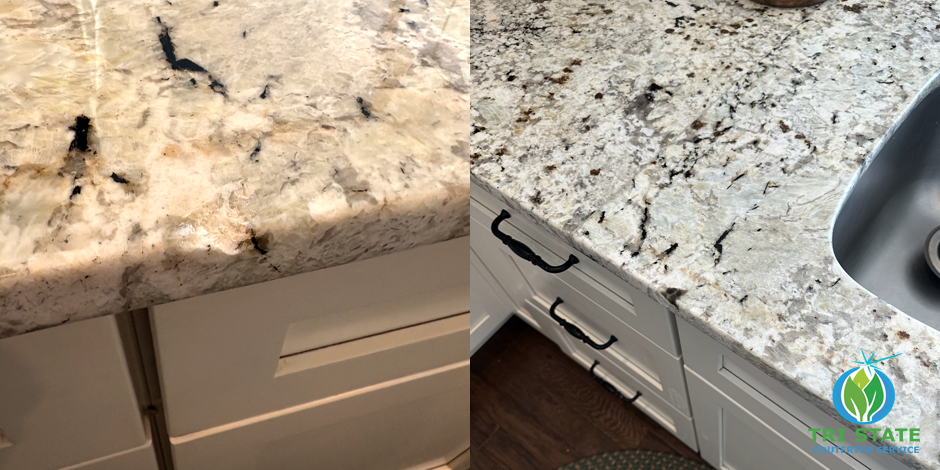
Granite countertop edge chip repair is one of the most common repair requirements. Countertop edges are exposed to cookware, appliances, dishes, and everyday kitchen activity. Even a relatively small impact can remove a piece of stone from an edge.
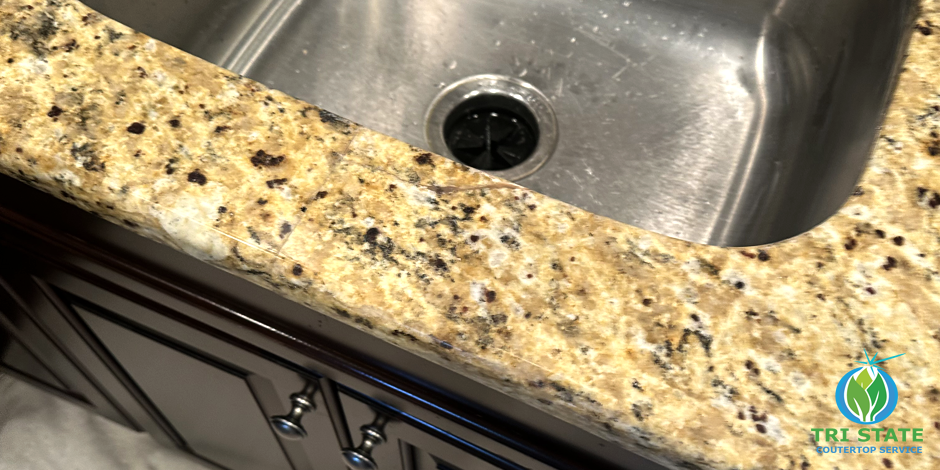
Sink areas are another common location. Homeowners frequently move heavy dishes, pots, and other objects around the sink, increasing the possibility of accidental impact.
Granite countertop corners can also chip because they are exposed and often have a more defined edge profile. A professional technician may be able to rebuild the damaged corner and recreate the original shape.
How Does Professional Granite Countertop Chip Repair Work?
1. Inspection of the Damage
The first step is to inspect the damaged area. The technician evaluates the chip's size, depth, location, and surrounding stone. They also check whether the chip is connected to a crack or another structural issue.
2. Cleaning and Preparation
The damaged section is thoroughly cleaned and prepared. Dust, loose stone particles, grease, and other contaminants must be removed so the repair material can bond effectively with the granite.
3. Color and Material Matching
Granite comes in a wide variety of colors and natural patterns. Professional repair requires careful consideration of the existing stone so the repair does not appear as an obvious contrasting patch.
Depending on the repair, specially selected or color-tinted resin or epoxy may be used to reproduce the appearance of the surrounding granite.
4. Filling and Rebuilding the Chip
The missing section is filled with the appropriate repair material. Larger edge or corner chips may require more detailed rebuilding so that the original shape and profile can be recreated.
5. Shaping and Leveling
After the repair material has properly cured, the repaired section is carefully shaped and leveled. This step is particularly important for countertop edges because the repaired area needs to follow the original contour.
6. Finishing and Polishing
The final stage involves refining the repaired area and, where appropriate, polishing it to match the surrounding surface. Proper finishing can significantly improve the overall appearance of the repair.
Will a Granite Chip Repair Be Completely Invisible?
The visibility of a repair depends on several factors, including the size of the chip, the location, the color and pattern of the granite, and the type of finish.
A repair on a relatively uniform granite surface may blend extremely well. Highly patterned granite can be more challenging because natural veining and mineral variations are difficult to reproduce precisely.
A professional repair should aim to make the damaged area as unobtrusive as reasonably possible. However, homeowners should understand that natural stone has unique variations, so an exact reproduction of every grain and vein may not always be possible.
Can a Large Granite Countertop Chip Be Repaired?
In many cases, larger chips can still be repaired, although the process can be more complex. A large edge chip may require rebuilding the missing portion rather than simply filling a small hole.
The condition of the surrounding stone is also important. If a large chip is connected to a crack, movement, separation, or other structural damage, the underlying problem should be evaluated before completing cosmetic restoration.
This is one reason professional assessment is valuable. Repairing only the visible portion of a problem may not provide a lasting solution if the countertop has an underlying structural issue.
Do You Have to Replace the Entire Granite Countertop?
Not necessarily. An isolated chip generally does not require complete countertop replacement. If the countertop remains structurally sound and the damage is localized, professional repair may be a more practical option.
Replacing an entire granite countertop can involve removing the existing slab, transporting a new stone, modifying plumbing or appliances, and installing a new surface. When repair is technically suitable, restoring the existing countertop can reduce unnecessary disruption.
Replacement may become appropriate when the slab has extensive structural damage, severe breakage, multiple major cracks, or conditions that make reliable repair impractical.
Granite Countertop Chip Repair vs. DIY Repair
Home improvement stores sell various granite repair kits, and DIY repair may appear attractive for a very small chip. However, achieving a professional result can be more difficult than simply filling the damaged area.
Color matching, resin application, edge shaping, curing, leveling, and polishing all affect the final result. A poorly matched or improperly finished repair may be more noticeable than the original chip.
Professional granite countertop repair is especially worth considering when the damage is located on a prominent edge, corner, sink area, or valuable natural-stone surface.

How to Prevent Granite Countertop Chips
Although granite is durable, careful everyday use can help reduce the risk of future damage.
- Avoid dropping heavy cookware onto countertop edges.
- Handle cast-iron cookware carefully near exposed edges.
- Do not strike countertop corners with heavy objects.
- Use protective boards when working with heavy kitchen equipment.
- Take care when moving appliances across or near the countertop.
- Have cracks or damaged seams inspected before they become larger problems.
- Keep repaired areas protected from unnecessary impact.
Why Choose Tri-State Marble Countertop Care?
Tri-State Marble Countertop Care specializes in professional countertop repair and natural-stone restoration. Our approach focuses on evaluating the actual condition of the countertop and determining whether repair, polishing, or restoration can provide a practical alternative to replacement.
Our services can help address common countertop problems including chips, cracks, damaged edges, worn surfaces, seams, and polishing requirements. Professional restoration can improve both the appearance and usability of an existing stone surface.
If your granite countertop has suffered a chip, professional evaluation can help you understand the available options before you commit to a costly replacement. Visit www.tristatemarblepolishing.co to learn more about our countertop repair and restoration services.
Frequently Asked Questions About Granite Countertop Chip Repair
Can a chipped granite countertop be repaired without replacing it?
Yes. Many small and moderate chips can be professionally repaired without replacing the entire countertop. The appropriate method depends on the size, location, depth, and condition of the damage.
How much does granite countertop chip repair cost?
The cost varies according to the size and location of the chip, the granite type, the complexity of the repair, and the finishing required. A professional assessment is the best way to determine the specific repair cost.
Can a chip near a granite sink be repaired?
Yes. Chips around sink cutouts are often repairable. Because sink areas experience frequent use, proper preparation, bonding, shaping, and finishing are particularly important.
Can a granite countertop edge chip be repaired?
Yes. Many edge chips can be rebuilt and reshaped to restore the original countertop profile. The result depends on the amount of missing stone and the condition of the surrounding area.
Is granite chip repair better than replacing the countertop?
When the damage is isolated and the countertop remains structurally sound, repair can be a practical alternative to replacement. A professional should evaluate extensive cracks or structural damage before recommending repair.
Final Thoughts
A chipped granite countertop does not automatically mean you need a new countertop. Granite countertop chip repair can restore many isolated chips, damaged edges, and corners while allowing homeowners to preserve their existing stone.
The most important step is determining whether the damage is isolated or connected to a larger structural problem. Professional repair can also provide a better finish than an improvised DIY solution, particularly when color matching and edge restoration are involved.
If you have a chipped, cracked, worn, or damaged granite countertop, Tri-State Marble Countertop Care can help you explore professional repair and restoration options. Visit www.tristatemarblepolishing.co for more information.